Trello-based maintenance management system
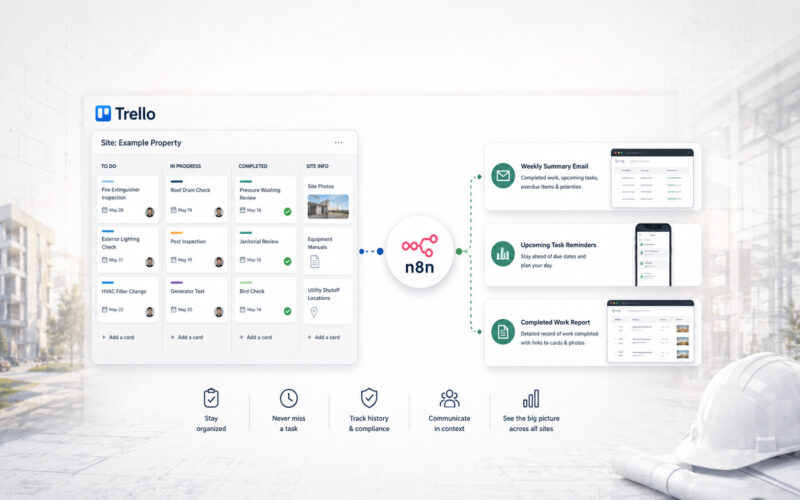
Built a Trello-based maintenance system for recurring inspections, site knowledge, work history, subcontractor follow-up, and automated reporting across commercial properties.
Digital Tools & Systems
Created a plain-language maintenance performance dashboard that turned a broad property role into clear expectations for ownership, tasks, communication, and professionalism.
At Pentillion Construction, the property maintenance role covers a wide range of responsibilities across roughly a dozen commercial properties, including outdoor malls, tenant spaces, and mixed-use sites. The work includes routine inspections, garbage removal, cleaning, minor repairs, contractor coordination, task tracking, and responding to issues raised by tenants, property managers, and owners.
Although the role is important, the expectations were not always easy to define. Good maintenance often goes unnoticed. When the work is done well, tenants and customers simply experience a clean, functional, well-managed property. That can make the role feel thankless, but it also makes clear expectations more important.
Small visible issues, such as mud on a front door, overflowing garbage, or damaged finishes, can quickly create complaints and reduce confidence in the maintenance team. I identified a need to better define what successful performance looked like for the maintenance role, especially because the job required more than simply completing assigned tasks.
Technicians needed to take ownership of their sites, understand priority and billing boundaries, use Trello consistently, communicate clearly, and know when work should be escalated or subcontracted rather than handled in-house.
To address that, I created a job dashboard for the Property Maintenance Technician role. The dashboard condensed the role into four key performance areas: Site Ownership & Accountability, Task Management & Prioritization, Communication & Coordination, and Professionalism & Tenant Interaction.
Each category included a plain-language summary, detailed expectations, measurable indicators, and reflection prompts that could be used for onboarding, coaching, and performance discussions. The idea was to make the role easier to understand without reducing it to a checklist of disconnected tasks.
The dashboard helped translate informal feedback into a shared standard. Instead of expectations being passed along through phone calls or individual training styles, the technician had a clear reference point for what mattered most: keeping sites visibly cared for, tracking tasks properly, spending time on approved work, communicating before problems escalated, and identifying work that should be handled by outside contractors.
The result was clearer role definition for new hires and existing technicians. It reduced billing mistakes, encouraged more consistent use of Trello, and helped management evaluate performance more fairly. It also reinforced the larger operational goal: maintenance should create confidence. Property managers, owners, tenants, and customers should be able to see that the site is being looked after, even when the best result is that nothing appears to be wrong.
Related
A few related projects with the same kind of problem-solving thread.
Built a Trello-based maintenance system for recurring inspections, site knowledge, work history, subcontractor follow-up, and automated reporting across commercial properties.
Digital Tools & Systems
At Pentillion Construction, I implemented a Trello-based maintenance management and reporting system for recurring work across a dozen commercial properties. The system replaced phone calls, personal notes, and memory-based tracking with site-specific boards, recurring templates, photo documentation, manuals, procedures, accountability labels, and automated n8n reporting.
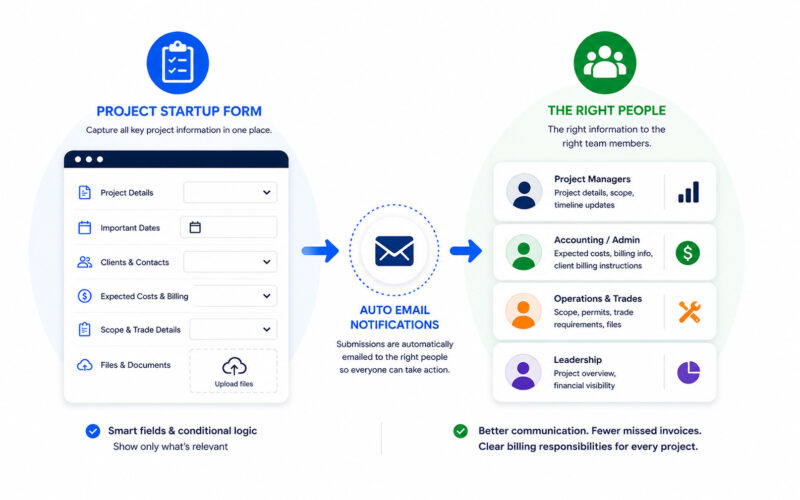
Built an internal project-startup workflow that captured awarded-work details, billing responsibilities, expected costs, permits, contacts, and file uploads into a clearer handoff between project managers and office administration.
Digital Tools & Systems
As Process Improvement Manager at Pentillion Construction, I built an internal project startup workflow to close the gap between a project being awarded and the information needed for billing, accounting setup, project management, and office administration.
Before the workflow, important project details could be known by one person but not clearly passed to the other people who needed them. That created risk around expected costs, invoicing, accounting setup, project contacts, permit requirements, file storage, and complex billing situations where costs might be split between property managers, tenants, landlords, or other clients.
I designed the workflow, built the startup form, configured auto-populated dropdowns and conditional logic, tested the process, and set up automatic email submissions to the people who needed the information. The form captured project status, project lead, client and site contacts, expected costs, billing responsibilities, important dates, scope notes, permit requirements, file uploads, and trade-specific details.
The form made the startup process harder to skip and easier to complete. It reduced reliance on memory and one-off messages, helped project managers and office staff see newly awarded work earlier, gave accounting clearer billing instructions, reduced missed invoices, and made complicated billing handoffs easier to manage.
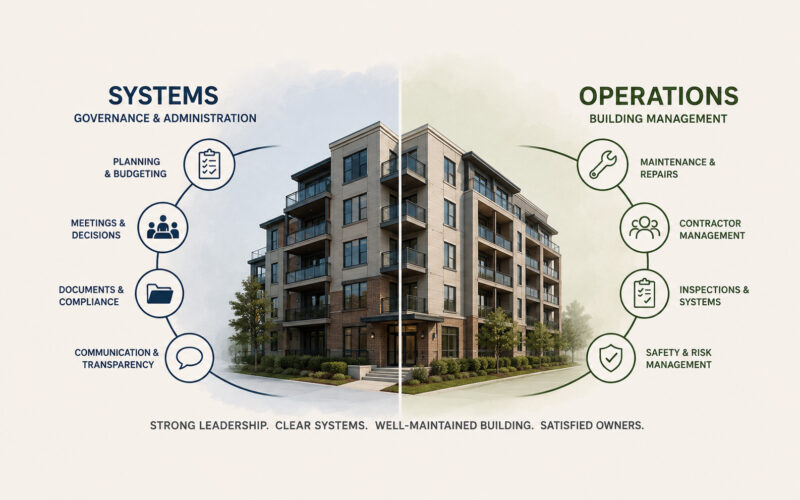
Helped professionalize a mixed-use strata through governance systems, owner communication, financial tracking, maintenance planning, contractor coordination, and on-site management.
Buildings & Spaces
Over multiple terms as Strata President, and later as on-site Building Operations Coordinator, I helped turn a mixed-use strata into a more organized, transparent, and financially disciplined operation. The work combined governance, owner communication, contractor coordination, maintenance planning, budget oversight, legal/bylaw review, records, and practical on-site troubleshooting.