Photo frame guessing game
Built a laser-cut photo-frame guessing game with flipping tiles, integrated card storage, and a browser crop tool for printable photo sheets.
Creative & Community
Personal furniture, signs, laser-cut work, graphics, a light box, and a wedding ring design. A small collection of things I’ve made outside of formal work projects.
Related
A few related projects with the same kind of problem-solving thread.
Built a laser-cut photo-frame guessing game with flipping tiles, integrated card storage, and a browser crop tool for printable photo sheets.
Products & Devices
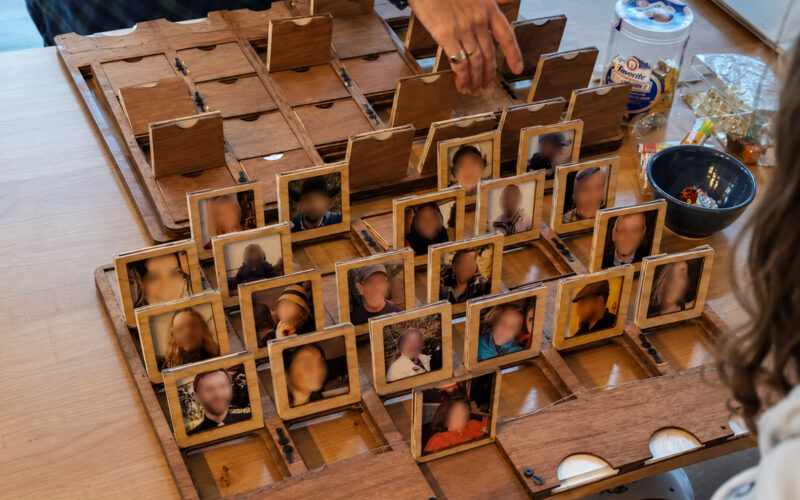
Remember this game? I designed and built a custom photo-frame guessing game as a personal gift, using real photos of family, friends, and pets. The finished piece was laser cut from layered plywood, assembled by hand, and designed to work both as a playable game and a displayable photo frame.
Sometimes I go overboard with Christmas presents. The flipping tiles needed to move smoothly, the layers had to align cleanly, and the matching photo cards needed integrated storage so the game stayed self-contained.
Preparing the photos became its own workflow problem, so I built a small browser-based crop tool that turned inconsistent source images into consistent portrait squares and arranged them onto printable 4 by 6 layouts. That means the game can be updated with new memories over time instead of being locked to the first photo set.
The nostalgic gift became a mix of product design, fabrication, woodworking, and lightweight web-app development.
Designed a personal business card and identity system to make a broad mix of engineering, construction, design, communication, and practical problem-solving feel clear and connected.
Creative & Community
I designed my business card as a compact expression of how I work: make things, make sense of things, and carry ideas through to completion. The project turned a broad professional identity into a physical card using geometry, colour, language, proportion, and a clear working philosophy.
The card needed to do more than hold my name and contact information. It had to communicate a broader professional identity: engineering, project management, construction, design, communication, systems thinking, and practical follow-through, without making the work feel scattered.
The central challenge was clarity. My work crosses different domains, so the card had to create a thread that tied them together. I wanted it to feel professional and capable, but still human, creative, and specific to me.
The logo combines my initials, R and C, with references to squaring the circle, the golden ratio, and a 3-4-5 triangle. Those references connect the identity to philosophy, mathematics, construction, and design. The geometry is not there as decoration; it reflects the way I tend to approach work: look for structure, understand the constraint, and find a practical path forward.
The sketched line quality was intentional. I did not want the mark to feel overly polished or sterile. The slightly drawn quality suggests thinking, iteration, and problem-solving in progress. It keeps the identity connected to the process of working through an idea, not only the final result.
The colour palette reinforces the same idea. The charcoal grey has a pencil-lead quality, which connects to sketching, drafting, and working something out by hand. The deep construction-gold adds warmth, value, and a practical built-environment association. The two-tone name treatment connects directly back to the logo so the initials and wordmark feel like one system rather than separate graphic elements.
The back of the card centres on the phrase “Make It / Make Sense.” I like the phrase because it carries two meanings at once. It speaks to making, building, and execution, but also to sensemaking, clarity, and communication. Separating the phrase into two lines turns a familiar expression into a simple statement of how I work.
The supporting line, “Design. Solve. Build. Deliver.” turns that philosophy into a process. It reflects the sequence I naturally bring to projects: understand the problem, design a response, solve the constraints, build the result, and deliver something that works.
This project is personal, but it supports the same idea as the rest of the portfolio. The card was a small physical object, but the design problem was the same kind of problem I often work on: make something broad and complicated clear enough that someone else can understand it, use it, and remember it.
Built a temporary 240-guest farm wedding venue with camping, parking, washrooms, water, power, lighting, a large tent, live music, and a custom dance floor.
Creative & Community
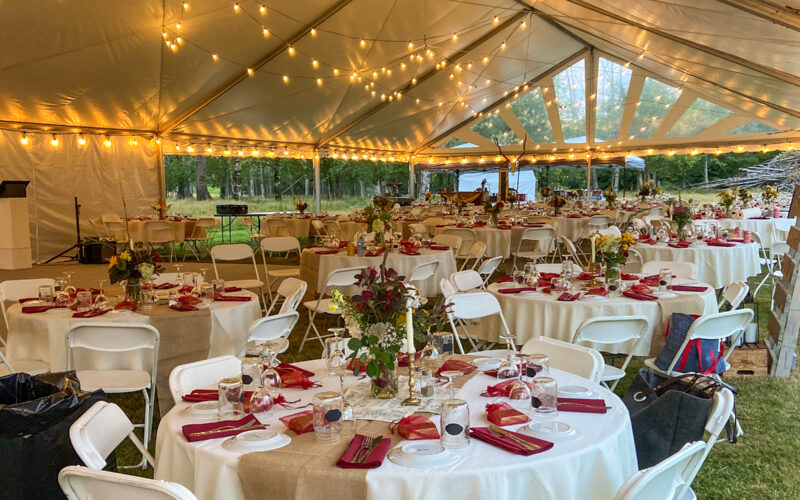
For our wedding, my wife and I turned an overgrown working farm into a temporary private venue for 240 guests. The project involved long-range planning, site preparation, camping and parking layouts, washrooms, temporary water service, power distribution, and lighting. It also included a 100’ x 40’ tent, a custom 20’ x 32’ dance floor, live music, food service, volunteer coordination, and handmade guest experiences.